
Based on the noise simulator in the initial Refinement of Intervention, I have made improvements and feature additions to improve its accuracy and user experience. Below are the specific features, technical support, and progress the improved noise simulator made.
1. Addition of functionality
Street noise simulation :
- In the improved version, the simulation is not limited to appliance noise but also includes street noise. The user can simulate the street noise level of the area at different times of the day by entering a postcode (e.g., E20 1JU). This feature helps users understand the noise levels in their area when choosing a place to live (e.g., renting, buying a house, or choosing a hotel) so that they can make a more appropriate decision.
- Supported by the ‘Urbansound8k’ database: https://urbansounddataset.weebly.com/urbansound8k.html
Multi-noise source simulation:
- While the original version could only simulate a single noise source, I am developing a system that can simulate up to five noise sources in the new version. This means that users will be able to simulate multiple noise sources (e.g., air conditioning, TV, outside street noise, etc.) at the same time, allowing them to more realistically experience the effects of noise in their living environment.
2. Changes in technical support
In the original version, I used convolution reverb to simulate the effect of noise propagation in houses. However, I found that a purely algorithmic simulation of convolution was rather mediocre and did not allow for flexible resizing of the house, as most convolutional reverberations were based on sampling a fixed real-world environment. To solve this problem, I upgraded the technique to HRTF-based simulation.
HRTF (Head-Related Transfer Function) is a method for simulating the human ear’s perception of sound sources at different orientations and distances. It very accurately simulates the effects of position, orientation, and distance of a sound source by recording sampling points around the head.
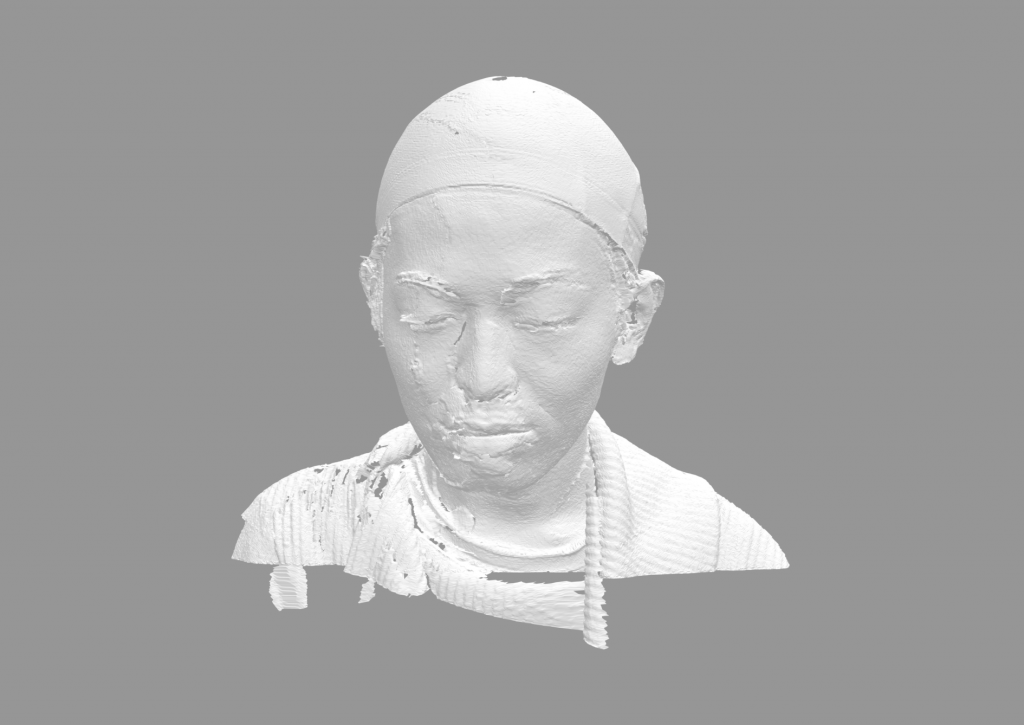
Advantages of using HRTF:
You can adjust the noise source according to the orientation and distance of the sound, add appropriate filters, decibel attenuation and other effects to simulate a more realistic sound perception.
3. Current development progress
HRTF base architecture:
HRTF files with 72 azimuths, 13 elevation angles and 1 distance difference are currently used for the initial construction. This infrastructure supports the simulation of sound sources with different azimuths and distances, and can more accurately reproduce the spatial sense of the noise propagation process.
UI Development:
The current project has developed an initial user interface (UI) for basic user testing.
Features include:
- Noise Source Selection: Users can select different appliances or city noises to simulate.
- Orientation Controls: The user can control the azimuth of the sound source by adjusting the controls on the UI.
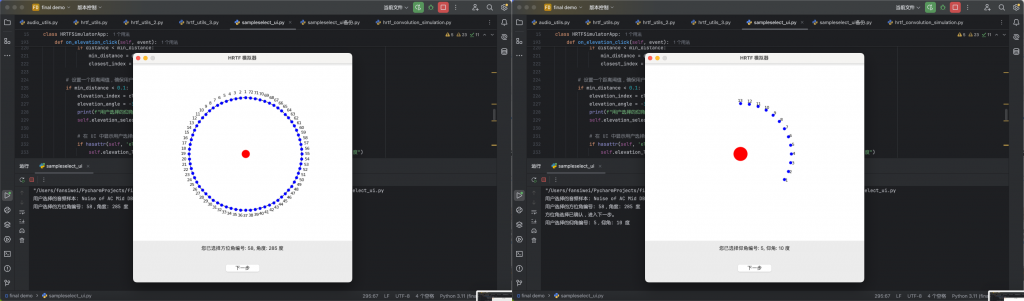

- Elevation Angle Adjustment: Users can control the head orientation and change the elevation angle to experience different noise propagation feelings.
- Noise Playback: Users can playback and experience the simulated noise effects to assess the impact of noise in their living environment.
Current functionality flaws:
Currently, users are unable to browse the complete sample library, and the expected appliance layout optimisation function and noise recognition function have not yet been developed.


But through this series of improvements and technological upgrades, the Noise Simulator is able to more accurately simulate multiple sources of noise in the living environment, helping users to perceive and select suitable living spaces in advance. Meanwhile, the HRTF-based simulation will significantly enhance noise sources’ positioning accuracy and propagation perception, making this intervention more practical and realistic. The project is currently in the development and testing phase and will continue to optimise the user experience and technical implementation in the future.
Tests of the intervention:
Intervention testing was based on a small group of participants, including a selection of peers and interviewees.
As the current procedure is not yet fully encapsulated, it is not possible to test the actual effects of the noise simulator in a realistic scenario. However, the new version of the noise simulator based on the HRTF (Head-Related Transfer Function) showed a high degree of realism for the test sample. Participants gave better feedback on its noise localisation and spatial simulation features.
In addition, some participants indicated that the noise simulator could work with platforms such as Airbnb and Amazon as a plug-in rather than a stand-alone programme to provide more direct assistance functions in specific scenarios.